How to Fact-Check AI Answers: A 5-Minute Routine for Small Businesses
31 Oct 2026 · AI Fundamentals
How to Fact-Check AI Answers: A 5-Minute Routine for Small Businesses

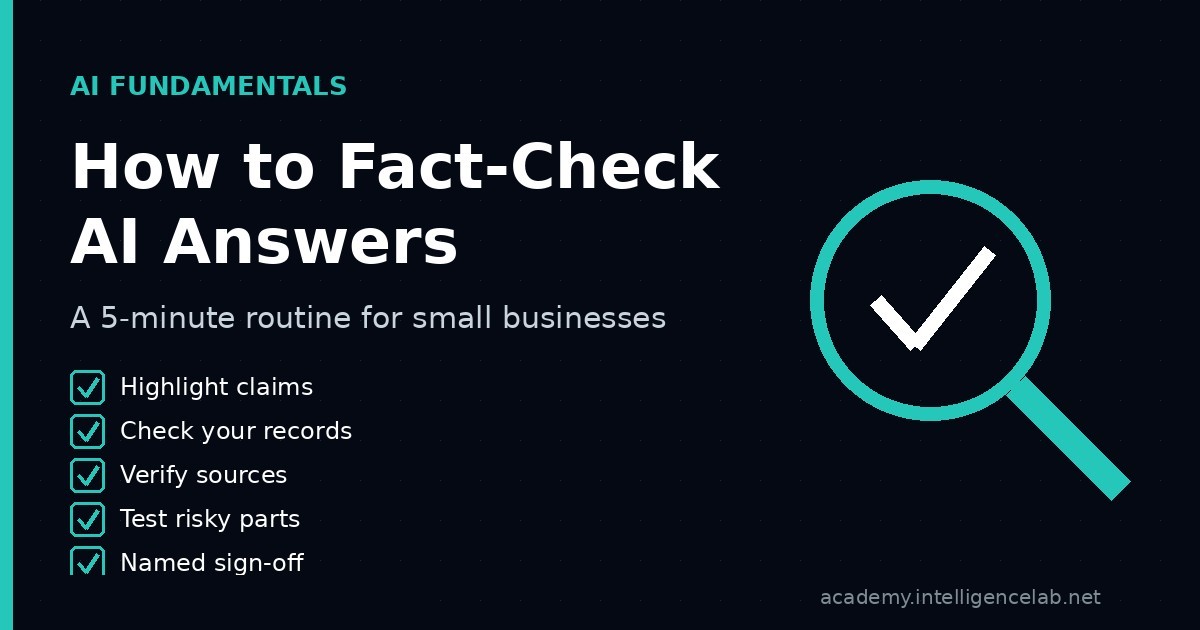
Short answer: AI tools can write fluent, confident text that is simply wrong, so treat every AI answer as a first draft, not a fact. A five-minute check before you publish or send anything catches most problems: mark the claims that matter, check each one against a source you trust, test the risky parts, and make sure a person signs off. Your business stays responsible for what the AI says on your behalf. If you're just getting started with AI tools, the free course AI Essentials for Business covers the basics.
Why AI gets things wrong
Generative AI tools predict likely words. They are very good at sounding right, and that is exactly the problem: a made-up price, a wrong opening time or an invented regulation reads just as smoothly as a correct one. The US National Institute of Standards and Technology calls this risk "confabulation" and describes it as "the production of confidently stated but erroneous or false content (known colloquially as 'hallucinations' or 'fabrications') by which users may be misled or deceived" in its Generative AI Profile (NIST AI 600-1).
The tool doesn't know your business. It doesn't know that you changed your returns policy last month, that you stopped delivering to a certain area, or that a supplier raised prices. Unless you give it that information, it will fill the gap with something plausible.
Why it matters for a small business
When AI writes your website copy, a customer email or a chatbot answer, customers see it as your business speaking. A well-known example comes from Canada. As BBC Travel reported in February 2024, Air Canada's website chatbot told a passenger he could claim a bereavement fare after his trip, which wasn't the airline's policy. The airline argued the chatbot was responsible for its own actions. The British Columbia Civil Resolution Tribunal disagreed and ordered the airline to pay damages and fees, noting that it makes no difference whether information comes from a static page or a chatbot.
The lesson for any business is simple: you own what your AI tools publish. A short, repeatable check is far cheaper than fixing a wrong promise after a customer has relied on it.
The 5-minute fact-check routine
You don't need special software for this. You need a habit. Run these five steps on anything AI writes before it leaves your business.
Step 1: Highlight the claims that matter (1 minute)
Read the draft once and mark every statement a customer could act on or hold you to: prices, dates, opening hours, delivery times, product features, guarantees, legal or tax statements, health or safety advice, numbers and statistics, and quotes or names. Everything else, such as tone and wording, matters less. You are looking for facts, not style.
Step 2: Check each claim against your own source (2 minutes)
For each highlighted claim, find where the truth lives: your price list, your terms and conditions, your booking system, your product sheet or your last invoice. If the AI says "free delivery over 50 euros" and your shop says 60, the shop wins. Keep a short "facts sheet" with your current prices, policies and contact details, and paste it into the AI tool when you ask for a draft. Grounding the tool in your own information cuts errors at the source.
Step 3: Verify outside facts at the original source (1 minute)
If the draft cites a law, a statistic or a study, open the original: the official regulator page, the government website or the publisher of the report. Don't trust a link just because the AI produced it; AI tools can invent references or point to pages that don't say what they claim. If you can't find the source in a minute, remove the claim or rewrite it without the number. A vague but true sentence beats a precise but false one.
Step 4: Test the risky parts (30 seconds)
Ask yourself three quick questions. Does this promise something we don't offer? Does it give advice we aren't qualified to give, such as legal, medical or financial advice? Does it mention a real person or competitor in a way we couldn't defend? If the answer to any of these is yes, rewrite that part yourself.
Step 5: A named person signs off (30 seconds)
Decide who approves AI-assisted content before it goes out, and make it a person, not a job title nobody holds. For low-risk content such as social posts, the author can approve their own work after the check. For anything with prices, contracts, complaints or regulated topics, a second pair of eyes is worth it.
Watch out for personal data
Accuracy also matters when AI handles information about people. Under UK and EU data protection law, personal data you hold must be accurate and, where necessary, kept up to date, as the UK Information Commissioner's Office explains in its guide to the accuracy principle. If you use AI to summarise customer notes or fill in a CRM, check that it hasn't invented or merged details about a real person. And only share the personal data the task actually needs.
Make it easier with better prompts
You can prevent many errors before they happen by changing how you ask:
- Give it your facts. Paste your facts sheet and say "only use the information below."
- Allow "I don't know". Add "if the information isn't provided, say so instead of guessing."
- Ask it to flag claims. Try "list every factual claim in your answer and say where it came from." This gives you a ready-made checklist for Step 1.
- Keep tasks small. A short product description is easier to check than a 2,000-word article written in one go.
A simple checklist to print
- Claims that matter are highlighted.
- Each claim matches our own records.
- Outside facts are checked at the original source, or removed.
- No promises, advice or statements we can't stand behind.
- Personal data is accurate and kept to the minimum.
- A named person approved it.
Pin it next to your screen for a couple of weeks. After that, it becomes second nature.
FAQ
Can I stop AI tools from making things up completely?
No current tool can guarantee that. You can reduce errors a lot by giving the tool your own information and telling it not to guess, but a human check is still needed for anything that matters.
Do I need to check every social media post?
Check any post that includes facts: prices, dates, offers or numbers. A post that only shares an opinion or a photo caption needs a lighter read for tone.
Are AI tools with web search more reliable?
They can point you to sources, which makes checking faster, but they can still misread or misquote a page. Open the source and confirm it says what the answer claims.
Where can I learn the basics of using AI safely?
Our free course AI Essentials for Business walks through everyday AI tasks, prompting and safe use for small teams. If you'd like to try a range of AI writing and image tools in one place, you can also create an account on the Intelligence Lab AI platform.
0 Comments
Categories
- AI Fundamentals 2
- AI Automation & Agents 2
- AI for Marketing & Content 1
- AI Leadership & Strategy 1
- AI for Web & WordPress 1
Recent posts
AI for Customer Emails: Reply Faster Without Losing Trust
Wed, 28 Oct 2026

AI for Your WordPress Website: 6 Practical Wins for Small Businesses
Sat, 24 Oct 2026
Leave a comment